
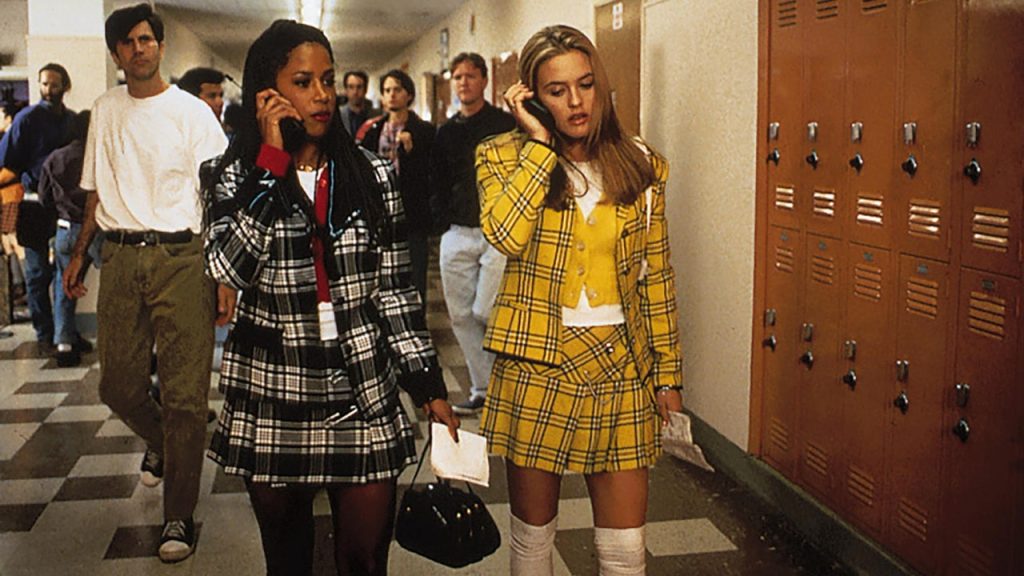
In Clueless (1995), director Amy Heckerling created a representation of female youth rarely seen before or since. The film’s three main female characters – Cher Horowitz (Alicia Silverstone), Dionne Davenport (Stacey Dash) and Tai Frasier (Brittany Murphy) – have more depth, substance and intelligence than the vast majority of women seen in teen films, comedies and cinema in general. While they are, as the film’s title suggests, clueless in many situations, their ignorant traits are much more realistic for adolescents than the traits of most young women seen on screen. Unlike many of their counterparts in other similar films, Clueless’ characters also display intellect, compassion and honesty, even when talking about the touchy subject that is teenage sex.
The title of Clueless could not be more apt; cluelessness in the young female characters is at the core of an overwhelming majority of the film’s jokes and plays a vital role in driving the plot forward. Until her final-act realisation that she is “totally clueless” (Clueless 1995), Cher was blissful in her ignorance. “Cher’s movements between cluelessness and understanding and back again form the moral structure of this story – a story that details the dangers of egocentricity but with great comic style,” David Kelly says (2003, p. 12). Her moments of thoughtfulness and savviness – such as when she shows up Josh Lucas’ (Paul Rudd) girlfriend Heather (Susan Mohun) when Heather misquotes Hamlet (c. 1599) in the car – cannot be ignored, but complementing these are the ignorant and oblivious remarks which make Cher the watchable and hilarious character she is (Kelly 2003). Cher’s friends also possess a similarly defining naïveté: Tai spends a number of scenes in an emotional state induced by a desire to be with Elton Tiscia (Jeremy Sisto), a boy whose interest in himself dwarfs his interest in her, and one of Dionne’s most memorable scenes comes after she leaves the comforts of suburban Beverly Hills and panics while driving on the freeway. The misjudgement of her connection with Christian Stovitz (Justin Walker) from Cher herself is iconic in its cluelessness, and this is but one of the sticky situations Cher becomes entangled in when the ability to use her argumentative skills is taken away from her. Despite a valiant attempt to garner sympathy by highlighting her dress was made by a “totally important designer” (Clueless 1995), Cher’s mastery of manipulation also fails to come to her aid when she is mugged at gunpoint whilst alone at a literal and metaphorical crossroads. So, she leans on the one character who repeatedly shows they are clued into the intricacies of Cher’s ignorance: her witty and wise ex-stepbrother and eventual romantic partner, Josh. The oldest character the audience is able to somewhat properly get to know, Josh is the yin to Cher’s yang, and the balance he brings to her life is what draws Cher towards him. “The joys of cluelessness are always balanced by the satisfactions of being clued in, and the comic poise of the film arises from the balance it achieves between its keen sense of the pleasures of each” (Kelly 2003, p. 6). And despite probably not knowing it, almost all real-life young people – the film’s primary audience – share at least some of Cher and her friends’ cluelessness, deepening the humour and dramatic irony intrinsic in their characters and thus making Clueless the cultural phenomenon it has become.
Where many characters in other teen films would not be, Clueless’ women are open, honest, and non-judgemental about the sexuality of themselves and their peers. During a casual conversation in a bustling restaurant, the three main young females candidly describe their respective sexual statuses: Tai has lost her virginity, Dionne says she is “technically a virgin” but “[her] man is satisfied” and has “no cause for complaints”, and the “hymenally challenged” Cher is “not interested in doing it until [she finds] the right person” (Clueless 1995). Each character is comfortable in her own skin. No spiteful or envious barbs are slung across the restaurant table following the discussion, but instead Dionne and Cher playfully throw bread at each other, continuing their friendship and onto the next topic of discussion. Touching on the film’s portrayal of sex in her book Clueless: American Youth in the 1990s, Lesley Speed says, “Clueless is significant for centring on a virgin who is neither depicted more favourably than other characters nor ostracised” (2017, p. 49). Speed continues, highlighting how the popular girl’s standing as a virgin “engages with the teen genre’s role as a source of ideas for young people about sex” (2017, p. 49). Writing in Risky Business: Sexual Risk and Responsibility Messages in Teen Sex Romps, Cassandra Alexopolous and Laramie D Taylor scientifically explain the influence of teen films on their sexually developing audiences, emphasising the effect of observation on learning, whether said observation is through a real-life or fictional lens (Alexopolous & Taylor 2020). “Through observation, people learn not only how to enact specific behaviors and general classes of behavior, but also under what circumstances those behaviors are appropriate and what consequences they are likely to elicit. In the case of sex, this means learning not just how to have sex but what behaviors are sexual, which of those behaviors are appropriate with whom, and what consequences are likely to result from those behaviors,” they say (2020, p. 2162). In this critical sexual decision-making stage of their lives where curiosity naturally increases, young people can be easily influenced by the films they watch, books they read and games they play (Alexopolous & Taylor 2020). Clueless being the film it is, with its centring around young and popular characters, means its representation of youthful women and sex has a seismic effect on its target audience. Due to the balance of Cher, Dionne and Tai’s different sexual lifestyles, Clueless leaves none of its audience, regardless of their sex life, feeling uncool, uncomfortable, or unincluded.
In her writing and directing of Clueless, Amy Heckerling dared to create characters and relationships that neither conformed to type nor were a guaranteed drawcard for cinemagoers. According to Timothy Shary in Generation Multiplex: The Image of Youth in Contemporary American Cinema (2014, p. 8), there were “six major approaches to youth cinema” in Hollywood around and just prior to the era of Clueless: “the science saga, the horror thriller, the romantic melodrama, the sex comedy, the juvenile delinquent film, and the school picture that often borrowed generic elements from the rest”. This film is an ovular peg that does not quite fit into any of these round genre holes. Clueless earned commercial success despite being a non-standard hybrid of previously successful genres, much like Heckerling’s feature debut Fast Times at Ridgemont High (1982) (2014, p. 8). Unlike in Fast Times though,Heckerling’s female Clueless characters are almost totally sheltered from suicides, violence, racial conflicts, financial troubles, familial unrest, drug-fuelled antics and sexual turmoil (Wald 2002). Similarly to Shary’s earlier assertion, Lesley Speed highlights Clueless’ exploration of “relationships between femininity and feminism, youth, humour and consumer culture” (2017, p. 3) which lies in stark contrast to the usual cinematic “domination, firstly by adults and secondly by male teenagers” (Speed 1995, p. 24). Typically, successful comedies in the late twentieth century focused on an intensely hysterical male actor, such as Mike Myers, Adam Sandler, or Jim Carrey (Speed 2017). This trend was perhaps unsustainable though; “six of ten highest-grossing motion pictures of all time, adjusted for inflation, are principally about adolescent girls – either their experience or the treatment they receive in male culture” (Gateward & Pomerance 2002, p. 14). It was never a matter of if females would star in comedies, but how they would be represented. To this day, there is a largely untapped market – mostly made up of adolescents – which wants to watch films about young women behaving as real-life young women do. When it comes to realistic representation of females, almost all other classic films centred on teenagers – whether it be Grease (1978), Ferris Bueller’s Day Off (1986), or the more fantasy-based Carrie (1976) or Heathers (1988) – pale in comparison to Clueless. Clueless helped Hollywood dip its toes into the water and, according to Isabel Walcott (cited in Hunting 2014, p. 145), “opened people’s eyes to the fact that if they could get teenage girls to come to a movie, they could make a killing”.
Despite it being disguised by “Valley girl” looks, a penchant for fashion demonstrating a strong sense of materialism, and cluelessness in many scenarios, Cher, unlike many other young female lead characters, often displays sharp intellect throughout the film. Dionne labels makeovers Cher’s “main thrill in life”, saying they give her “a sense of control in a world full of chaos” (Clueless 1995) and Lesley Speed finds “the relationship between fashion and power in the film centres on the ritual of the makeover” (2017, p. 51), but makeovers are not the protagonist’s only outlet for displaying a burning desire for influence and authority. Her rousing speeches excite and uplift their respective classroom audiences but most notably, more often than not, Cher is smart enough to know how to get her way. Mel Horowitz (Dan Hedaya), Cher’s father, is a lawyer whose rhetorical influence on his daughter is abundantly clear throughout the entire film; an upgrade from C+ to A- in physical education being “totally based on [Cher’s] powers of persuasion” and Mel saying he “couldn’t be happier than if they were based on real grades” (Clueless 1995) is one of many examples of this. Whilst her character fits the mould in many other ways, Cher’s linguistic skills break the stereotype of the “dumb blonde” seen in films made before and after Clueless, including Marilyn Monroe as Sugar “Kane” Kowalczyk in Some Like It Hot (1959) and the Mean Girls (2004) character Karen Smith, played by Amanda Seyfried. Clueless’ promotional tagline leads people to think the film is another one about dumb blondes, but “Sex. Clothes. Popularity. Is There A Problem Here?” (cited in Speed 2017, p. 49) is, according to Catherine Driscoll, contradictory in that the film does not focus on sex as much as the tagline implies (cited in Speed 2017). It is of course difficult to perfectly capture both the essence and important intricacies of a film in a tagline, but this example does not at all display the difference between how women are represented in Clueless compared to other teen films. Cher, Dionne and Tai all show qualities of kindness, love, intelligence and compassion throughout Clueless, but this simplistic tagline paints these characters as akin to “the Plastics” in Mean Girls. Occasionally in cinema, a blonde female character possessing traits that cannot be extrapolated from appearance alone is created – Kat Stratford in the also-classic-literature-based 10 Things I Hate About You (1999) is one – but this remains the exception rather than the rule and is testament to Heckerling’s bold representation of young women in Clueless.
Amy Heckerling and her co-creators of Clueless were taking a 12-million-dollar risk by putting this film with almost never-before-seen female character types together. It well and truly paid off for them. Just like real-life teenagers, Cher, Dionne and Tai have their strengths and weaknesses and are not just people whose qualities can be determined by appearance. They can be kind and honest, yet still, on occasion, hilariously clueless. Despite having not quite worked out how everything in life works, they possess the lovable traits which made them and Clueless such a success, both commercially and in its influence on people. Compared to depictions in almost every other film, the substance and depth in these characters shine through and make Clueless’ representation of female youth simply brilliant.
References
Alexopolous, C & Taylor, LD 2020, ‘Risky Business: Sexual Risk and Responsibility Messages in Teen Sex Romps’, Sexuality & culture, vol. 24, no. 6, pp. 2161-82, <https://link-springer-com.ezproxy.lib.rmit.edu.au/article/10.1007/s12119-020-09742-4>.
Gateward, F & Pomerance, M 2002, ‘Introduction’, in F Gateward & M Pomerance (eds), Sugar, Spice, and Everything Nice: Cinemas of Girlhood, Wayne State University Press, Detroit, Michigan, pp. 13-24, <https://books.google.com.au/books?id=ywsajx7jqAMC&printsec=frontcover#v=onepage&q=contents&f=false>.
Clueless 1995, Netflix, Paramount Pictures, Hollywood, California, directed by Amy Heckerling, <https://www.netflix.com/watch/384406>.
Hunting, K 2014, ‘Furiously Franchised: Clueless, Convergence Culture, and the Female-Focused Franchise’, Cinema Journal, vol. 53, no.3, pp. 145-151, <https://muse-jhu-edu.ezproxy.lib.rmit.edu.au/article/543853>.
Kelly, D 2003, ‘Emma, Cher and the Maze of Unknowing’, Sydney studies in English, vol. 29, pp. 3-15, <https://search-informit-org.ezproxy.lib.rmit.edu.au/doi/epdf/10.3316/ielapa.200401935>.
Shary, T 2014, Generation multiplex: the image of youth in America since 1980, University of Texas Press, Austin, Texas, <https://ap01-a.alma.exlibrisgroup.com/view/delivery/61RMIT_INST/12246210600001341>.
Speed, L 1995, ‘Good Fun and Bad Hair Days: Girls in Teen Film’, Metro (Melbourne), vol. 101, pp. 24-30, <https://search-informit-org.ezproxy.lib.rmit.edu.au/doi/epdf/10.3316/ielapa.155718296819653>.
Speed, L 2017, Clueless: American Youth in the 1990s, Taylor & Francis Group, London, UK, <https://ebookcentral.proquest.com/lib/rmit/reader.action?docID=4890826>.
Wald, G 2002, ‘Clueless in the Neocolonial World Order’, in F Gateward & M Pomerance (eds), Sugar, Spice, and Everything Nice: Cinemas of Girlhood, Wayne State University Press, Detroit, Michigan, pp. 103-21, <https://books.google.com.au/books?id=ywsajx7jqAMC&printsec=frontcover#v=onepage&q=contents&f=false>.
 Harper Pestinger
Leave a comment